A Guide to Opening a Corporate Bank Account for Foreign Entrepreneurs.
This guide provides a comprehensive overview of the process for foreign entrepreneurs to open a corporate bank account in South Korea. This is a mandatory step for conducting any business and financial transactions after establishing a corporation.
Overview of the Process
The process can be broken down into four main steps:
- Complete Corporation Establishment: Ensure all legal and registration processes for your corporation are finalized.
- Bank Selection & Pre-consultation: Choose a bank and consult with them to understand their specific requirements.
- Prepare and Submit Documents: Gather all necessary documents for submission.
- Account Management and Limit Removal: Understand the rules of account usage and how to remove initial transaction limits.
Step 1: Corporation Establishment Completed
Before you can open a corporate bank account, your company must be fully registered. This means you must have completed the following:
• Issuance of Corporate Registration Certificate: This is the official document proving your company is legally registered.
• Creation of a Corporate Seal: A physical, registered seal (인감, ingam) is required for official documents.
• Completion of Business Registration: You must have your business registration certificate from the tax office.
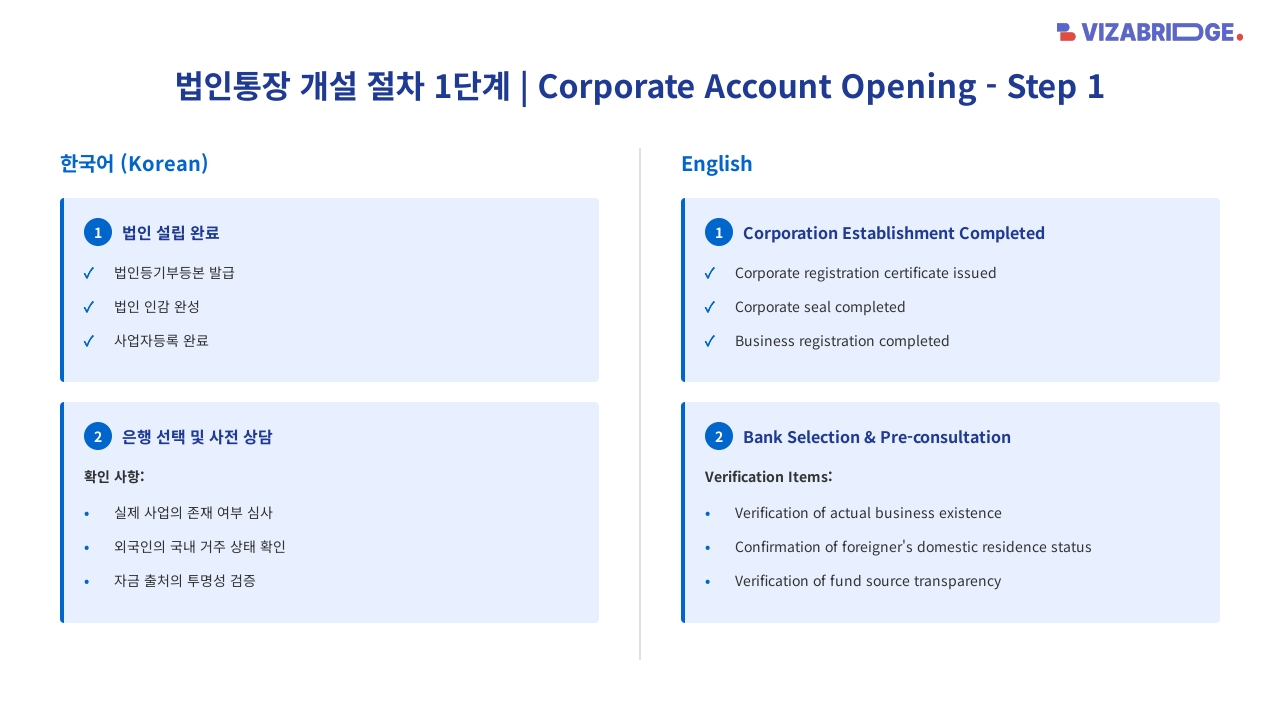
Step 2: Bank Selection & Pre-consultation
When you approach a bank, they will conduct a preliminary review. Be prepared for them to verify the following:
• Verification of Actual Business Existence: The bank will check if your business is a legitimate, operating entity.
• Confirmation of Foreigner's Domestic Residence Status: Your legal status as a resident in Korea will be confirmed.
• Verification of Fund Source Transparency: You must be able to prove the source of your initial investment capital to ensure transparency and prevent money laundering.
Step 3: Required Documents
Preparing the correct documents is crucial. The requirements are divided into two categories.
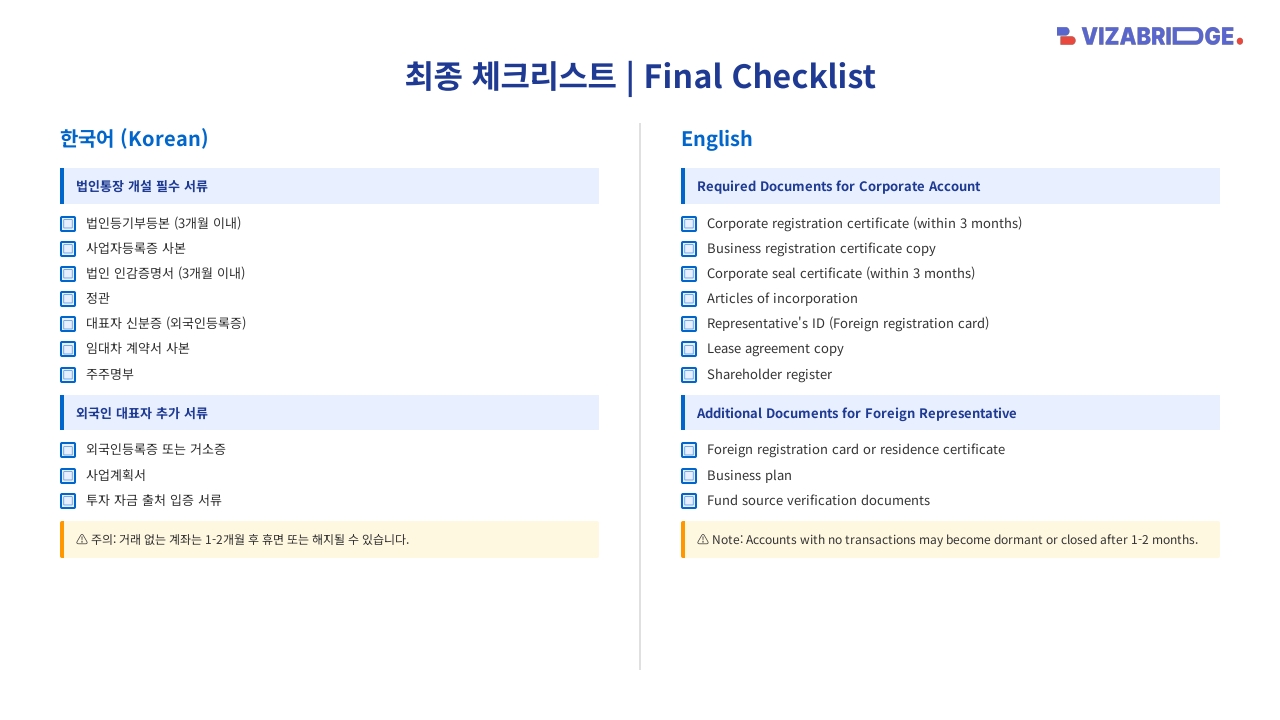
Basic Documents (Common for All Corporations)
| No. | Document Name | Notes |
| 1 | Corporate Registration Certificate | Must be issued within the last 3 months. |
| 2 | Business Registration Certificate | A copy is required. |
| 3 | Corporate Seal Certificate & Seal Impression | The certificate must be issued within the last 3 months. You will also need the physical seal. |
| 4 | Articles of Incorporation | To verify the purpose of the business. |
| 5 | Representative's ID | The ID of the official company representative. For foreigners, this is the Foreign Registration Card. |
| 6 | Lease Agreement Copy | A copy of the lease for your official office address. |
| 7 | Shareholder Register | A list of all shareholders in the corporation. |
Additional Documents for Foreign Representatives
| No. | Document Name | Notes |
| 1 | Foreign Registration Card or Residence Certificate | To prove your legal status in Korea. |
| 2 | Domestic Stay Purpose and Business Plan | This is especially important for accounts related to the initial capital deposit. |
| 3 | Investment Fund Source Verification Documents | Examples include overseas remittance details, bank statements, etc. |
Step 4: Account Management & Limit Removal
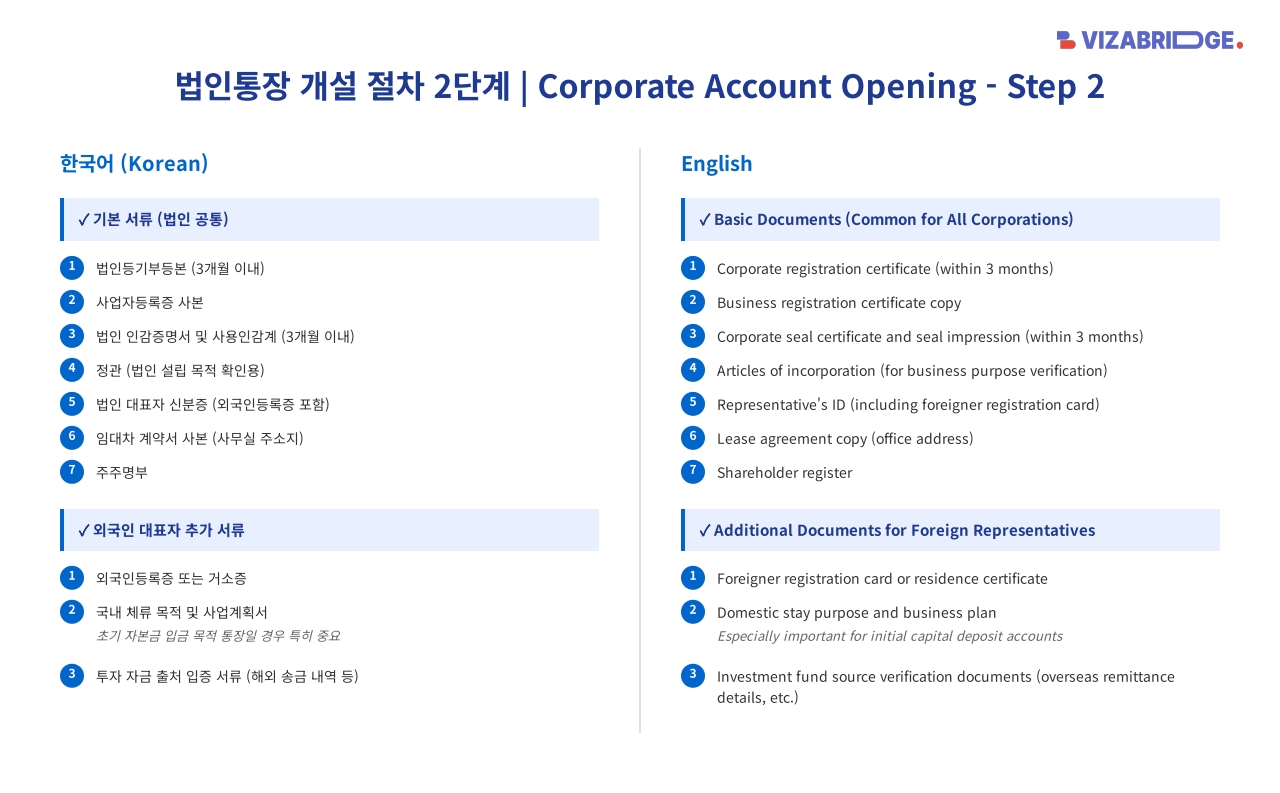
Precautions After Account Opening
• Transaction Purpose Compliance: All deposits and withdrawals must be strictly for business purposes. Personal use is prohibited.
• Dormant Account Prevention: If there are no transactions for 1-2 months, the account may become dormant or be closed.
• Money Laundering Prevention: Be aware that suspicious transactions may result in restrictions on the account or its closure.
Transaction Limits and Removal
• Initial Limit Setting: Newly created accounts have a low daily transaction limit (typically between 300,000 KRW and 2,000,000 KRW) to prevent financial fraud.
• Removing the Limit: To increase this limit for normal business operations, you typically need to submit evidence of legitimate business activity, such as tax invoices (세금계산서, segeum gyesanseo) issued for your sales.
Disclaimer: The required documents and procedures can vary slightly from bank to bank. It is highly recommended to contact your chosen bank branch directly for a pre-consultation to confirm their specific requirements before visiting.